Visita de John Arthur Eaves

El Lcdo John Arthur Eaves – caso de clase Vs navy por danos a la salud etc – estará hoy, lunes, 26 de abril, a las 6pm en el fortin para informar sobre nuevas gestiones en el congreso a favor de la salud en vieques … interesa hablar con líderes comunitarios que podrán divulgar la info a sus organizaciones …. aunque el caso terminó al determinar el tribunal federal que la Marina goza de “inmunidad soberana” en este caso …. John ya seguido en la búsqueda de posibles mecanismos para apoyar a vieques …. 26 de abril, a las 6 pm en el fortin. (English: The lawyer representing Vieques residents in a lawsuit against the US Navy for contaminating the island during military practices will be meeting with the community on Monday March 26 at 6 pm at the Fort.)

Support the demands of Vidas Viequenses Valen

Support the demands of Vidas Viequenses Valen

The Struggle Continues in Vieques

to achieve the just demands of its people

For more than 60 years, about a trillion pounds of explosives and toxic substances were dropped on Vieques by the U.S. Navy, NATO and their allies. After decades of protest and a campaign of non-violent, civil disobedience, the US Navy was forced to close the base on May 1, 2003.

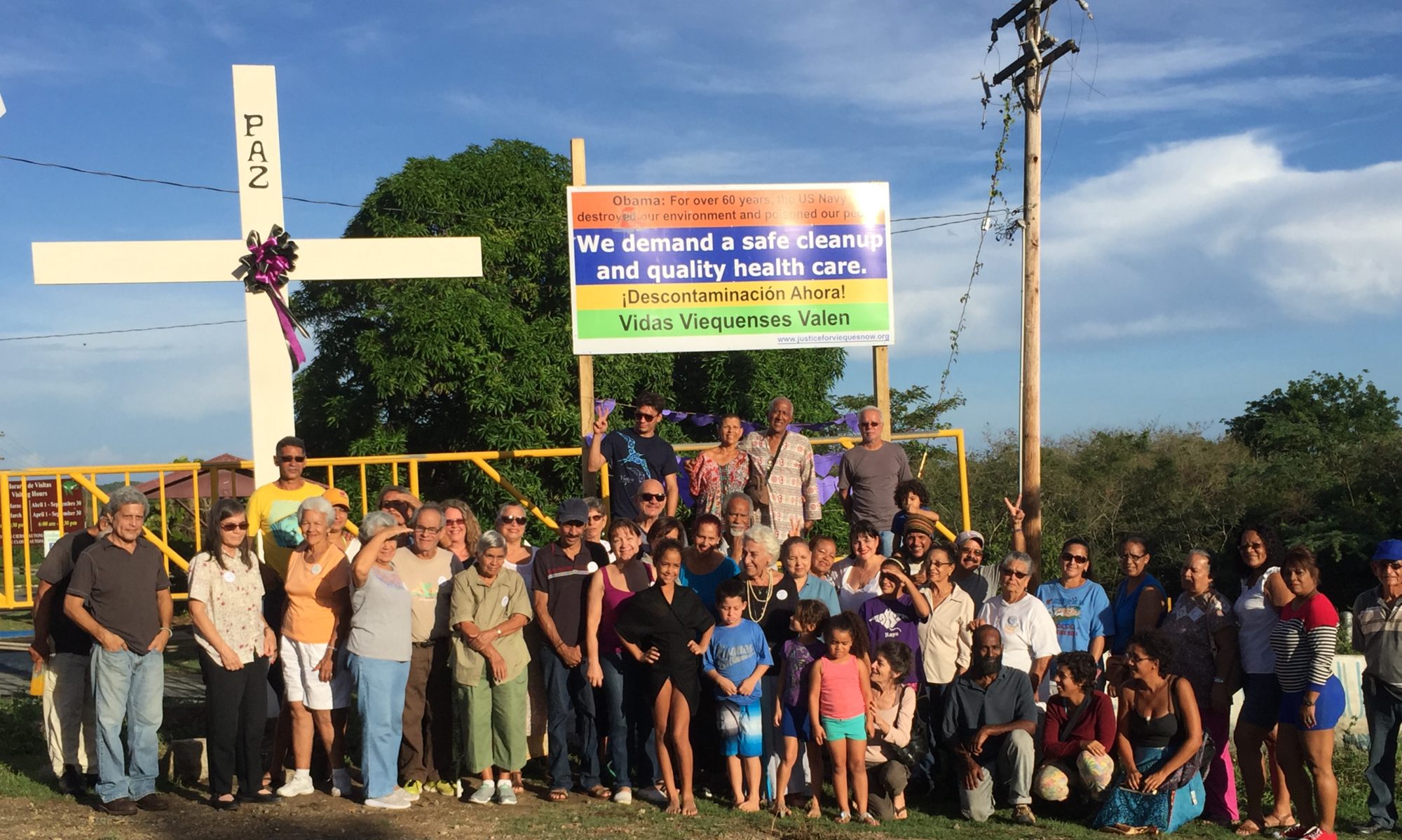
Although we celebrate the closing of the bombing range, the struggle continues because contamination and neglect continues to afflict our communities.  Vidas Viequenses Valen (VVV) was established by the people of Vieques in September of 2015 to continue the fight for justice.  We have organized several protests to remember the victims of cancer and other diseases caused by military toxics and to demand a safe and complete cleanup. In November 2015, a huge cross and a large sign reminding President Obama of his responsibility with Vieques was installed in front of the Navy’s former Camp Garcia.

Vidas Viequenses Valen continues to work through educational forums, peaceful protest, media publicity, meetings with public officials to achieve the “4 Ds“: the historic demands of Vieques:

Demilitarization – Demilitarization will not be complete until the remaining military installations, the ROTHR radar facility and the Mount Pirata telecommunications center, are closed.

Decontamination – We demand that the Navy assign an adequate budget to carry out a complete cleanup of the land and waters that they themselves contaminated with “conventional” arms (bombs, grenades, projectiles) and “non-conventional” arms (napalm, Agent Orange, depleted uranium).  We oppose the open detonation of unexploded ordnance (which is the cheapest form of removal) because it just continues poisoning us.  We demand the use of detonation chambers to protect our community from further contamination. We oppose the Navy’s use of signage and fencing on contaminated areas because it leaves the contamination in place. The Navy must promote genuine community participation in the process of decontamination, so that the cleanup will be thorough and effective.  Puerto Rican and Viequense companies must be granted the lucrative cleanup contracts which are now being given to U.S. companies.

Devolution (return of the lands) –  We demand the return of all of the land which is currently controlled by the federal government –  the U.S. Navy and the U.S. Fish and Wildlife Service (USFWS) – but first it must be restored to the condition in which it was found when it was expropriated in the 40’s.  Residents still have restricted access to about half of our 33,000 acres.

Development:   The type of development that is happening currently – which benefits primarily large scale projects and outside interests – gives little support to Viequenses. We support the Master Plan for Sustainable Development of Vieques which was approved by the Government of Puerto Rico in 2004.  This plan was prepared following the directives of the community, and promotes agriculture and fishing, eco-tourism, small guest houses, social interest housing, archaeology, and historic and environmental research, among other things.  Our people have been sickened by military toxics and suffer higher incidences of many diseases, including cancer, heart disease and diabetes. The federal government must compensate our people for the health problems resulting from the Navy’s activities.  We need a modern hospital, early screening and adequate care for our illnesses.  It is vital to establish efficient maritime and land transportation systems that respond to our needs, especially our needs to access health services in the main island of PR.

For more info: Myrna Pagán ([email protected]) o Ismael Guadalupe ([email protected]), Kathy Gannett: [email protected], 787-565-2717, www.justiceforviequesnow.org


Civilian exposure to munitions-specific carcinogens and resulting cancer risks for civilians on the Puerto Rican island of Vieques following military exercises from 1947 to 1998

Civilian exposure to munitions-specific carcinogens and resulting cancer risks for civilians on the Puerto Rican island of Vieques following military exercises from 1947 to 1998

Hans Sanderson, Patrik Fauser, Ricky Steven Stauber, Jesper Christensen, Per Løfstrøm & Thomas Becker To cite this article: Hans Sanderson, Patrik Fauser, Ricky Steven Stauber, Jesper Christensen, Per Løfstrøm & Thomas Becker (2017) Civilian exposure to munitions-specific carcinogens and resulting cancer risks for civilians on the Puerto Rican island of Vieques following military exercises from 1947 to 1998, Global Security: Health, Science and Policy, 2:1, 39-60 To link to this article: http://dx.doi.org/10.1080/23779497.2017.1369358

ABSTRACT
Estimation of legacy public health risks from munitions residues near or at former military test
ranges has for the past decades been a challenge to health authorities. Parts of the island of Vieques
(PR) were for six decades used for military training, and these are now declared as a Superfund site.
ATSDR has conducted site assessments there and found no cause for public health concerns. The
reports and findings of ATSDR have since been heavily contested and disputed. This paper provides
a case study on cancer risk screening of munitions-specific carcinogens for the full period of military
training on Vieques. Added cancer risks and Margins of Exposure for the different carcinogens for
each year were derived. We found that there is a potential for cancer risk concern related to BaP
exposures. Furthermore, there were health risks from TNT exposures. The primary exposure route of
these compounds was oral. The period 1992–1997 showed a significantly elevated lung and bronchus
cancer incidence rate in Vieques compared to Puerto Rico mainland mainly among women  and men 50–64 yr. These correlate with high munitions exposures in the period 1977–1984.

Full Paper Here

International Women’s Day Protest 2017

Women in Vieques (and their supporters) blocked the Main St. in front of the Post Office for an hour and a half on Wednesday, March 8, 2017,  as they participated with thousands of women around the world on International Women’s Day protests. Local women spoke out about the right to control their own bodies, education on gender issues, the need to reopen the Vieques maternity ward, need for specialists in Vieques to treat cancer and other diseases, need for a functioning ferry service, need for more well-paid jobs and pay equity, the need for healthy, organic food, among many other issues. Here is the video of our spirited picket.  See Spanish below.

COMUNICADO DE PRENSA

Para difusión inmediata

Paro Internacional de Mujeres en Vieques

Mujeres viequenses bloquean la calle principal de la capital de VIEQUES

8 marzo de 2017. Vieques, Puerto Rico: Hoy casi un centenar de personas se unieron al paro internacional de las Mujeres en Vieques, PR.   Mujeres viequenses bloquearon la calle principal de la capital Isabel Segunda de 11:00 AM a 12:30 PM para llamar atención a la situación grave de injusticias e incumplimiento del gobierno hacia las necesidades del pueblo de Vieques.

La cruzacalle que bloqueó la calle dijo “Mujeres en Contra de la Junta por la Salud de Vieques”.  Las consignas del día exigían la apertura de la sala de parto, trabajo digno y bien remunerado, mejoras en el sistema de transportación marítima, cero tolerancia a acoso sexual, entre otras.

Se hizo recolecta de cientos de firmas en una petición al Gobernador y a la Junta de Control Fiscal con los reclamos de la protesta.

Se pasó un micrófono entre las docenas de manifestantes del piquete ofreciendo la oportunidad a cada persona de expresar sus reclamos.


Celebramos el Día Internacional de Mujeres con un paro

(English below)

Este miércoles, 8 de marzo de 2017, en Vieques celebramos el Día Internacional de Mujeres con un paro de 1.5 horas de 11 AM – 12:30 PM  frente al correo en Isabel II.  Sea parte de mujeres en 30 países celebrando el miércoles.

La manifestación será pro derechos de mujeres, contra la austeridad que impone la Junta de Control Fiscal, y para atención a nuestra crisis de salud y transportación marítima y a la falta de trabajo digno y bien remunerado. 

Vestir de rojo. 

Hombres y mujeres bienvenidos. Aquí las palabras solidarias de Ismael Guadalupe: Me uno a esta convocatoria de la amiga Kathy. Hablar de la mujer es hablar de la madre,  de una abuela, de una hija, de una hermana o de la esposa: razones suficientes para decir presente en esta actividad. Estaré allí haciendo mío los reclamos por una sociedad más justa y equitativa. Ellas estuvieron bien activas en nuestra lucha contra la Marina , decenas fueron arrestadas y defendieron a Vieques contra el abusivo poder militar.

English: Come to celebrate International Women’s Day by participating in a one and a half hour work stoppage from 11 am to 12:30 PM in front of the Post Office this Wednesday. We will be part of dozens of countries with women striking on this day for women’s rights. In Vieques we will focus our demands to oppose the austerity of the Fiscal Control Board and to demand attention to our health crisis and ferry system crisis and for attention to a lack of dignified and well-paid jobs for women. Men welcome. WEAR RED as those around the world will be doing.

​Ithaca College study showing heavy metals (poison) in our plant life in Vieques related to military practices.

Ithaca College study showing heavy metals (poison) in our plant life in Vieques related to military practices.
SEE THE EXCELLENT VIDEO BELOW.
The crystal-clear water and white-sand beaches of the remote island of Vieques, Puerto Rico, are as postcard-worthy as any Caribbean destination. However, the flora that grows on the island may tell a different story: The United States Navy used Vieques as a bombing range from 1943 until 2003, testing landmines, guns and other artillery,affecting the ecosystems of the area. An Ithaca College student is conducting a study to see what effects this bombing has had on the area.Junior Danielle Bucior is a biology major conducting research about the contaminants the bombing left in the soil in Vieques. She traveled to Vieques in January to collect samples of the Scaevola taccada plant, a leafy green species that grows around the island, and is now testing them to check for heavy metals.Bucior received a grant for her research from the Rochester Academy of Science after writing an abstract including what her work entailed and why she wanted to pursue it. All biology students at the college conduct at least a semester of research as part of their degree requirements.Bucior said the military began cleaning up the island in 2006 in an effort to make it livable for humans. Though the island is working on opening public beaches and allowing people to swim, Bucior said she is still finding contaminants in the soil.“What I’m finding is that there are still a lot of heavy metals like titanium, lead and cadmium — things that shouldn’t be in the soil that are still there,” she said.

She said that as these plants take up the toxins, the animals that eat the plants consume the toxins, which progress up the food chain, eventually contributing to human consumption of toxins. Heavy metals like lead can cause health issues like cancer, blood problems and heart issues.

Biology professor Susan Swensen Witherup is Bucior’s research mentor. Witherup has a doctorate in plant physiology and genetics, and is working on the genetic mapping of the Scaevola plant. Bucior said Witherup invited her to work in her lab when she was a sophomore. The work originally involved research on pollination between native and invasive species in Vieques, but Bucior said she later enrolled in Witherup’s Biology of Oceanic Islands course that traveled to Vieques last year.

Witherup said she had collected plants from different geographic locations with the purpose of conducting analyses to compare genetic variances among plant populations. However, with these samples in hand, she said, she saw an opportunity to test for toxins with the knowledge of the island’s military history.

“It was just basically a shot in the dark,” she said. “It was like, ‘Well, hey, we know that this happened in Vieques, and we have all these different samples from all these different locations in Vieques. Why not also use these samples to look for a metal?’”

Bucior said that after researching and reading between 70 and 80 academic papers, she found one that related to her idea and modeled her research after it. She mapped the island based on where and to what degree the bombing occurred. During her trip, she collected more samples for her research from the various places on the island that she mapped.

“I learned a lot about the history, I got to talk to some of the people, and I just got really into it, learning about the environmental impacts of how we, as the American nation, came in, utilized the land and just kind of left it,” she said.

Witherup said her job as Bucior’s research mentor involves guiding the research, seeking funding and encouraging Bucior to present her work to academic journals. She said Bucior does all of the day-to-day work on the project, including collecting samples and conducting experiments.

Senior Adriana Morales is from Puerto Rico and works in the lab with Bucior on a separate project regarding the Scaevola plant’s genetic diversity. Morales’ project is similar to Bucior’s in that it involves the concept of conservation and utilizes the same type of plant. However, Morales’ work includes analyzing and researching to conserve the native species, Scaevola plumieri, and comparing it to the invasive species Scaevola taccada that was introduced by humans for the sake of tourism.

“Puerto Rico has really nice beaches, and so they usually build a lot of hotels or houses,” she said. “They usually tear everything apart, and then they do the building. When they try to make it like it was before, that’s when they bring in the taccada. And so they replant the taccada because it grows way faster and it looks very similar to the native one.”

Genetic diversity, she said, is essential for a healthy ecosystem. Morales said her work may also relate to Bucior’s due to the existence of heavy metals in the plants leading to genetic differentiation.