​Ithaca College study showing heavy metals (poison) in our plant life in Vieques related to military practices.

Ithaca College study showing heavy metals (poison) in our plant life in Vieques related to military practices.
SEE THE EXCELLENT VIDEO BELOW.
The crystal-clear water and white-sand beaches of the remote island of Vieques, Puerto Rico, are as postcard-worthy as any Caribbean destination. However, the flora that grows on the island may tell a different story: The United States Navy used Vieques as a bombing range from 1943 until 2003, testing landmines, guns and other artillery,affecting the ecosystems of the area. An Ithaca College student is conducting a study to see what effects this bombing has had on the area.Junior Danielle Bucior is a biology major conducting research about the contaminants the bombing left in the soil in Vieques. She traveled to Vieques in January to collect samples of the Scaevola taccada plant, a leafy green species that grows around the island, and is now testing them to check for heavy metals.Bucior received a grant for her research from the Rochester Academy of Science after writing an abstract including what her work entailed and why she wanted to pursue it. All biology students at the college conduct at least a semester of research as part of their degree requirements.Bucior said the military began cleaning up the island in 2006 in an effort to make it livable for humans. Though the island is working on opening public beaches and allowing people to swim, Bucior said she is still finding contaminants in the soil.“What I’m finding is that there are still a lot of heavy metals like titanium, lead and cadmium — things that shouldn’t be in the soil that are still there,” she said.

She said that as these plants take up the toxins, the animals that eat the plants consume the toxins, which progress up the food chain, eventually contributing to human consumption of toxins. Heavy metals like lead can cause health issues like cancer, blood problems and heart issues.

Biology professor Susan Swensen Witherup is Bucior’s research mentor. Witherup has a doctorate in plant physiology and genetics, and is working on the genetic mapping of the Scaevola plant. Bucior said Witherup invited her to work in her lab when she was a sophomore. The work originally involved research on pollination between native and invasive species in Vieques, but Bucior said she later enrolled in Witherup’s Biology of Oceanic Islands course that traveled to Vieques last year.

Witherup said she had collected plants from different geographic locations with the purpose of conducting analyses to compare genetic variances among plant populations. However, with these samples in hand, she said, she saw an opportunity to test for toxins with the knowledge of the island’s military history.

“It was just basically a shot in the dark,” she said. “It was like, ‘Well, hey, we know that this happened in Vieques, and we have all these different samples from all these different locations in Vieques. Why not also use these samples to look for a metal?’”

Bucior said that after researching and reading between 70 and 80 academic papers, she found one that related to her idea and modeled her research after it. She mapped the island based on where and to what degree the bombing occurred. During her trip, she collected more samples for her research from the various places on the island that she mapped.

“I learned a lot about the history, I got to talk to some of the people, and I just got really into it, learning about the environmental impacts of how we, as the American nation, came in, utilized the land and just kind of left it,” she said.

Witherup said her job as Bucior’s research mentor involves guiding the research, seeking funding and encouraging Bucior to present her work to academic journals. She said Bucior does all of the day-to-day work on the project, including collecting samples and conducting experiments.

Senior Adriana Morales is from Puerto Rico and works in the lab with Bucior on a separate project regarding the Scaevola plant’s genetic diversity. Morales’ project is similar to Bucior’s in that it involves the concept of conservation and utilizes the same type of plant. However, Morales’ work includes analyzing and researching to conserve the native species, Scaevola plumieri, and comparing it to the invasive species Scaevola taccada that was introduced by humans for the sake of tourism.

“Puerto Rico has really nice beaches, and so they usually build a lot of hotels or houses,” she said. “They usually tear everything apart, and then they do the building. When they try to make it like it was before, that’s when they bring in the taccada. And so they replant the taccada because it grows way faster and it looks very similar to the native one.”

Genetic diversity, she said, is essential for a healthy ecosystem. Morales said her work may also relate to Bucior’s due to the existence of heavy metals in the plants leading to genetic differentiation.

Congratulations to Vieques en Rescate

This weekend (January 23-24, 2016), Vieques en Rescate held a free acupuncture clinic at their offices.  Dozens of residents received treatment with priority for cancer patients.

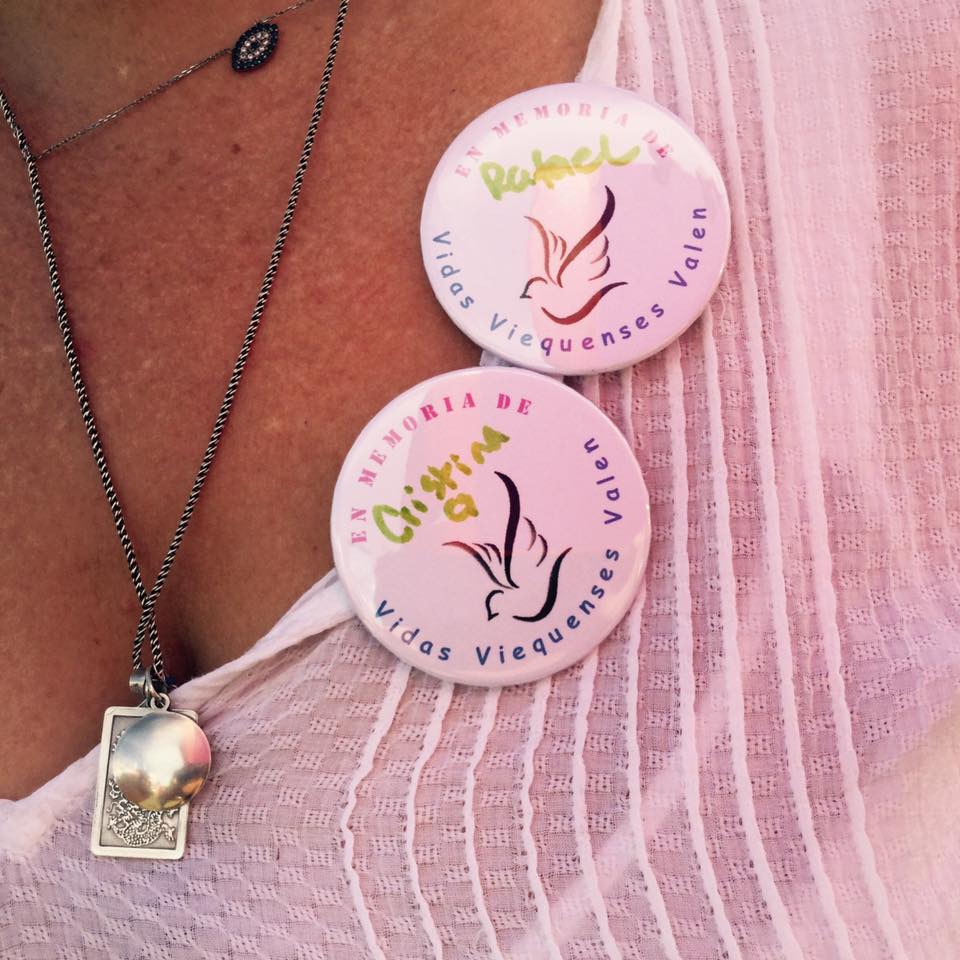
VER has registered more than 100 cancer patients in our small island of 9,000 residents. Patients receive free services such as medical supplies, transportation, etc.  Our cancer mortality rate is higher than most other places in PR perhaps because of the lack of health services, the military contamination, among other factors. Below are the buttons we made in memory of our cancer victims.

buttons

PLEASE SIGN THIS PETITION TO THE WHITE HOUSE TO RESOLVE THE HEALTH PROBLEMS OF VIEQUES

PLEASE SIGN THIS PETITION TO THE WHITE HOUSE TO RESOLVE THE HEALTH PROBLEMS OF VIEQUES.
cropped-Piquete-14-enero-2013-ante-de-la-Reunion-EPA-group-panoramic.jpg
Firmemos esta petición a la Casa Blanca a favor de una resolución de los problemas de salud en Vieques. Auspiciado por el abogado John Arthur Eaves.  Favor de hacer un “forward” a tus contactos.
Traducción por Google:
PEDIMOS A LA ADMINISTRACIÓN DE OBAMA QUE:
ACTÚA EN NOMBRE DE LOS CIUDADANOS DE LOS ESTADOS UNIDOS DE LA ISLA DE VIEQUES, PUERTO RICO
Nosotros, los ciudadanos de Estados Unidos de Vieques, somos extremadamente enfermos de cáncer, la diabetes, la cirrosis, y la hipertensión causados por la contaminación ambiental de los militares desde la Segunda Guerra Mundial. Miles de personas han muerto y morirán a causa de los metales pesados, agente naranja, el napalm, y otros compuestos tóxicos que se encuentran en la isla. Tenemos demandas contra la Secretaría de Salud para la ciencia negligente y conclusiones perjudiciales alcanzado por la ATSDR. Necesitamos un hospital, un centro de investigación para comprender los efectos de las toxinas, y la compensación parta reconstruir nuestras vidas. Debemos abordar los problemas críticos de salud, la contaminación ambiental, y la injusticia económica y materiales sufridos por los ciudadanos. Por favor, instruya al Secretario de Salud para resolver nuestras demandas y trabajar con nosotros para solucionar esta crisis y salvar a nuestros hijos.

Tributo a Nuestros Muertos de Cancer

Sign to Obama 2015 small
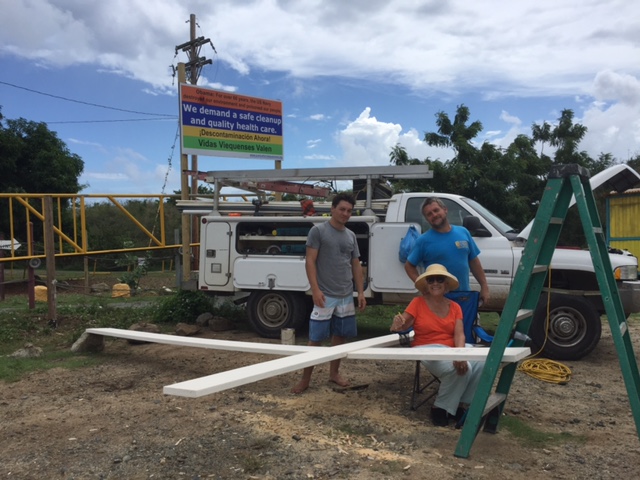
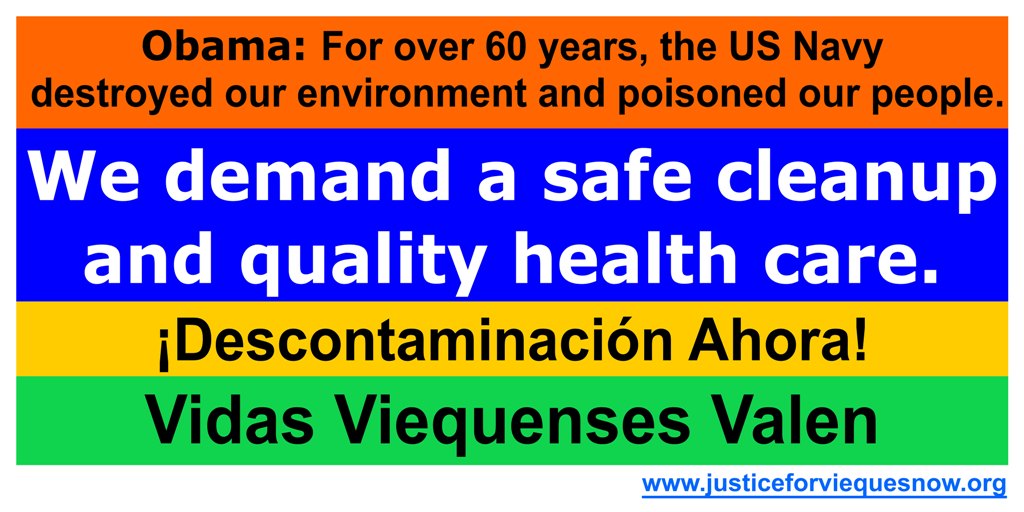
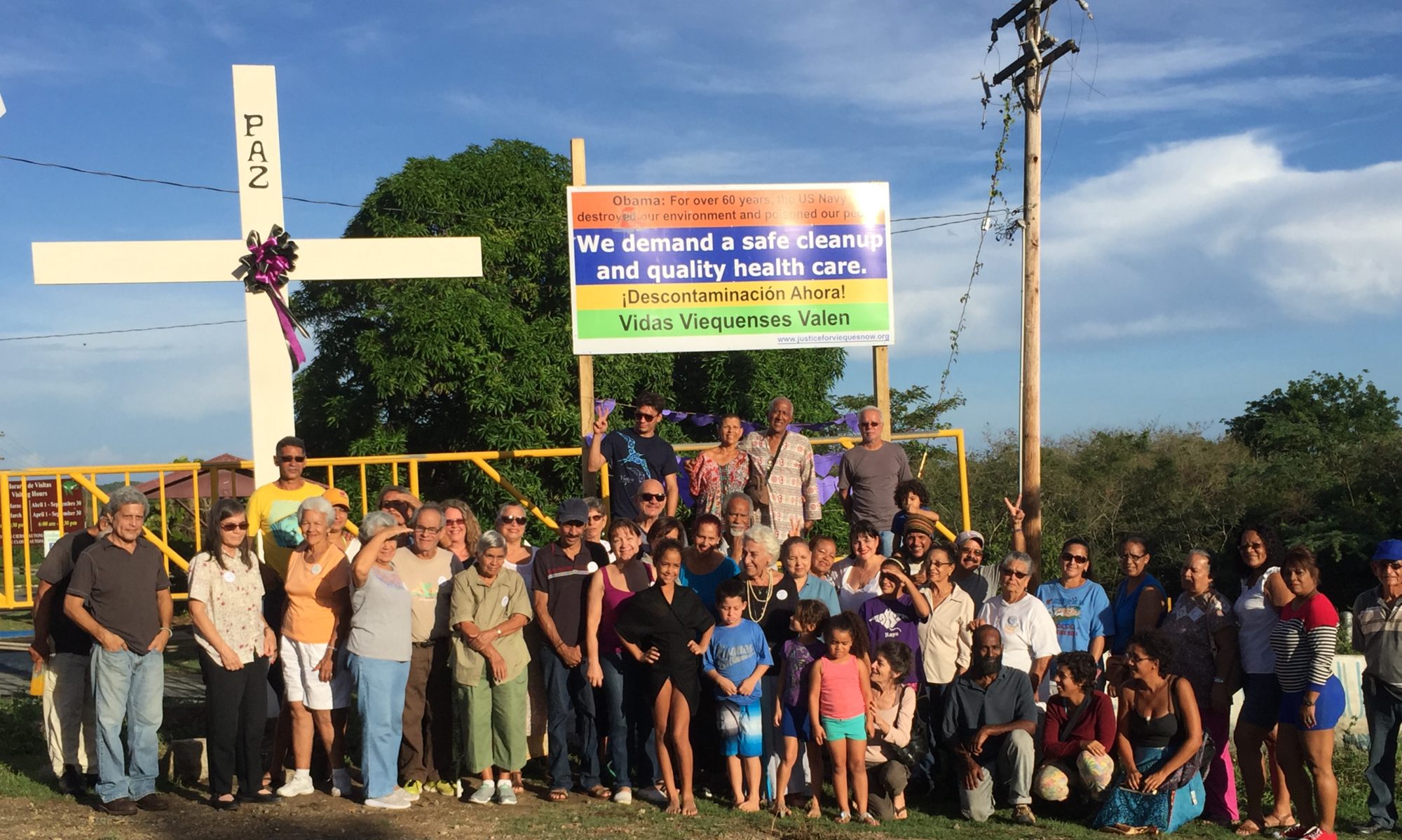
Sign to be installed at the entrance to the former Navy base on November 1, 2015.

Sunday, November 1, at 3 Pm we will have a Tribute to Our Cancer Victims. We will install a large cross and a sign with a message to President Obama at the entrance to the former Navy base. Vieques lives must be valued.

Paz y Justicia para Vieques! Ven al Tributo a Nuestros Muertos de Cáncer (otros enfermedades) este domingo, 1 de nov., a las 3 PM al frente del antiguo base. Trae flores en memoria de tu ser querido. Auspiciado por Vidas Viequenses Valen.

Viequenses colocarán una enorme cruz en tributo a los muertos de cáncer

Publicación Inmediata Comunicado de Prensa para

28 de octubre de 2015

Contactos: Myrna Pagán (818) 963-2344, Ismael Guadalupe (787) 612-0723 (portavoces del grupo Vidas Viequenses Valen)

Viequenses colocarán una enorme cruz en tributo a los muertos de cáncer.

Este domingo, primero de noviembre, el pueblo de Vieques colocará una enorme cruz en honor a las víctimas de cáncer y otras enfermedades causadas por los tóxicos militares.  El acto de conmemoración, organizado por el grupo Vidas Viequenses Valen (VVV), se celebrará frente a la antigua entrada del Campamento García a las 3:00 PM. Además se colocará un cartel grande recordando al Presidente Obama su responsabilidad con el pueblo viequense.

Sabemos que las actividades militares por más de seis décadas contaminaron nuestro ambiente produciendo cáncer y otras condiciones de salud fatales para nuestro pueblo. El histórico líder comunitario Ismael Guadalupe, quien recibe diálisis y espera un transplante del riñón, dice que “El gobierno de Puerto Rico al igual que la marina de guerra y otras agencias federales niegan que exista una alta mortandad por cáncer en Vieques. Aquí la mortandad por cáncer es una realidad que jamás podrá negarse con informes fatúlos ni con comunicados deprensa engañosos. Nosotros, los que vivimos en la Isla Nena, que padecemos y sufrimos el dolor de perder nuestras familias y amistades rechazamos esa aseveración.”

Ilsa Ortiz,  Presidenta del grupo Vieques en Rescate (VER), que presta servicios de apoyo a los pacientes de cáncer y mantiene un registro desde 2013 nos informa que al día de hoy han muerto 22 pacientes de los 92 a quienes se les ha prestado servicios.  Vieques sufre una crisis de salud.

“No podemos olvidar a nuestros muertos. Pondremos una Cruz de Esperanza frente al antiguo Campamento García, en memoria de nuestros seres queridos. El pueblo se unirá y con su amor y compromiso lograra justicia para Vieques”, señala Myrna Pagán, artista/activista viequense, sobreviviente de cáncer.

Para mas informacion, visita – www.justiceforviequesnow.org